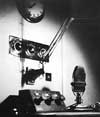
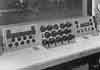
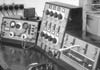
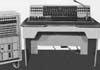
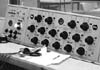
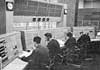
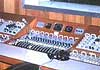
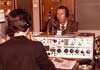
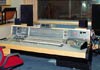
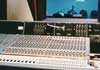
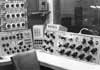
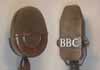
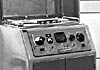
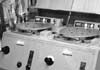
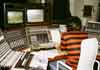
On these pages are pictures of old BBC radio equipment
and memories from the people who built, maintained and used it.
We don't aim at building a comprehensive history but to provide some 'snap-shots'
of times and places. Many thanks to all contributors of photos and information.
Compiled and edited by Roger Beckwith
Roger's home page |
Contact
Roger
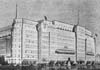
A comprehensive survey of the then new Broadcasting House, complete with a
detailed look at the studio and Control Room equipment.
Pictures of Belfast Control Room and two Dramatic Control Panels, some memories
of visits to Belfast in the mid-1930s and Radiolympia 1936/7 by L.G. Smith
and the 1937 Technical Instruction for the Regional DCPs.
Descriptions of the BBC's earliest recorders. The Blattnerphone and Marconi-Stille
machines recorded onto razor-sharp steel tape and the Philips-Miller used
a mechanical method to record on film.
Andrew Emmerson describes the extension to Broadcasting House that was never
built. He also discusses the Stronghold - an underground installation constructed
during the war and finally demolished in 2007 - and other underground war
precautions.
David Savage tells the story of defensive structures built to protect the
lower floors of Broadcasting House and the damage caused to BH, The Langham
and All Souls Church by bombing.
Mike Chessher and Barry Taylor describe the Broadcasting House Control Room
built during the war and here near the end of its life. Roy Hayward remembers
this installation during the war years. Also includes the 1943 TI for Wartime
Control Rooms & Studios and the 1946 TI for GTS.
This section features photographs taken during the war by BBC recording engineer
Reg Pidsley and pictures of preserved items. Also material about, and photos
of, correspondent Richard Sharp.
During the 1939-45 war, with many male staff serving in the armed forces,
Engineering Division trained some 800 women to work in Operations and Maintenance.
There can't be many radio stations built in railway tunnels. Gerald Daly was
Engineer in Charge of West Region during the war years and here, in a letter
written in 1974, he describes the CRR installation and how it came to be built.
Text and photographs from a March 1941 issue of the magazine 'Picture Post.'
The then DG, Frederic Ogilvie, wrote in the introduction to the article "Democracy
is fighting for its life. British broadcasting has a vital part to play in
that fight, and it plays it without abandoning its standards."
The home of some of the BBC's Overseas Services from 1941 to 1957 is recalled
by Joe Latham. The page includes some photos taken by Joe in 1949. Trevor
Hill remembers the war years at 200 and Rita Jaye a slightly later period.
There's also a memory of Trevor by David Babsky.
A variety of contributors look back on their BBC careers. The oldest of them
joined in the 1920s, several recall what BBC life was like during the Second
World War. Contributors: Horace Gregory, "LG" Smith, Johnny Longden, Ron Chown,
Mary Lawson, Michael Cooke, Rita Jaye, David Savage, Geoffrey Manuel, Sylvia
Wredden, Roy Hayward, Len Green, Geoff Leonard, Frank Doran, Joe Latham, Roy
Maynard, Barry Taylor, Mike Turner, Chris Davies and Jonathan Kempster.
Designed in the mid-1940s, some samples of the Type A survived in BH into
the 1970s. This section includes photographs of the first of the breed (which
was installed in studio 8A) as well as later variations, including a stereo
version.
Mike Chessher takes a tour of the studios and other technical areas. This
is a BH little changed since the war years.
An early desk design represented by colour photos of a preserved example and
the installations in Studio B5 in London and Channel W7 in Cardiff.
Bob Smith describes a transportable mixer designed by Johnny Longden for OB
use in the early 1960s. Ray White and Graham Harward remember the desks.
The new control room and continuities have replaced the old; new studios are
in use. Home, Light and Third are about to become history, as Mike Chessher
recalls.
Some photographs of a Type B studio in BH. More wanted please! There's also
a link to a fascinating technical description of the desks.
Photographs taken just before the Type B version of 3B and the adjacent recording
channel, H30, were withdrawn from service. Also three photos from Ariel featuring
the Today programme.
Descriptions of London's Type B Continuities and the Type D desks which replaced
them. Also a page featuring continuities at several venues in Cardiff.
Updated
July 2025.
Mike Chessher looks back on the brief career of this studio. He adds some
notes about Radio Sport through the 60s and into the 70s.
Photos of the construction of this area, photos from the 60s and 80s, a look
at the source selection system and the sources available in the early 60s
and memories. Much changed through the years, the area was finally taken out
of service on September 4th, 2006. Also includes the 1978 technical operator
recruitment booklet.
The Switching Centre in Broadcasting House was the focal point for vision circuits of the television network. Andy Hame describes the area and its work and, on a second page, the Audio and Telecommunications Area.
Three samples of the Type D. Mono versions for news and current affairs (3E
& 3G) and stereo versions (B13 & B6), including pictures of a 'Family
Favourites' session.
3G photos added May 2023.
Robert Smith describes the equipment used by BBC Local Radio stations. There
are photos from Radios Leicester, Teesside and Leeds. In the 50th anniversary
year of the start of Local Radio Robert looks at the digital equipment at
Radio Leicester.
The Neve desk in the Concert Hall of Broadcasting House (later the Radio Theatre)
seen in 1972. Also a 1940 photo shows the studio in use as a dormitory area.
The General Purpose desks made by Neve, Calrec and Audix which were the workhorses
of BH through the 1980s.
Away from BH, a description of the facilities and methods used at No.1 Bridge
Street, for thirteen years the home of the BBC's radio coverage of Parliament
and its successor, Millbank, bringing the story up to the 2020s.
Some of the converted London theatres and cinemas used for audience shows
and music recording. Also the control desk at the Royal Albert Hall in the
1970s/80s and the preserved master clock from Piccadilly studios.
Studio 8A seen in its final form before the 1932 building was renovated. A
studio which had a few 'firsts' to its credit.
Project Baseband studios and B6 photographed when new and shortly before they
closed just before the demolition of the Broadcasting House Extension.
Tony Nuttall recalls the Playhouse, the Control Room and one of the studios
in the early 1970s, plus photos of the 1929 Control Room. Also photos of the
demolition of NBH.
A selection of vintage mics - including the Marconi-Reisz and BT-H carbons
from the 1920s, the BBC A- and B-Types from the 30s and 40s and the PGS and
4038 from the 50s.
Ian Astbury describes the BBC's selection, specification and quality control
of recording tapes and discusses the various factors involved. The article
also covers the digital media that have gradually taken over from tape.
David Hughes remembers BTR/2s he has known, including the portable version,
and also discusses the BBC stereo rebuild, the RD4/4. Ken Banwell remembers
the machines at AP in the 1960s (added January 2023).
Photographs and descriptions of the grams found in studios in the early 1960s
- the TD/7, DRD/5 and RP2/1. Plus some test records and signature tunes. A
description of a pair of restored RP2/9s and the EMT 950.
Although this site is about radio, we take brief notice of the existence of
television! Colin Berwick looks back on his twenty years in BBC TV sound operations
and remembers the sound desk in TC6 in 1985. Nick Flowers recalls working
at AP in the 1960s.
Some pre-Corporation broadcasting dates; the running order of the TV programmes
that launched the BBC's regular "high definition" TV service in 1936; a look
at variations in the BBC's coat of arms, documents relating to levels and
dynamic range and sound effects, a memory of the day that Radio Caroline began
broadcasting, a description of the Mutterbox and photos of the demolition
of the BH extensions in 2007.
The museum includes displays of BBC equipment together with many domestic
radios and televisions and printed material. Please check this page for information
about opening hours.
Updated April 2022.
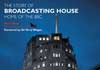
A splendid book about Broadcasting House was published in October 2008. "The
Story of Broadcasting House: Home of the BBC" by Mark Hines will interest
many visitors to this site.
An index of places and topics covered on this site.
Links to other sites with BBC equipment and related topics.
This is not an official site, and is not created or endorsed by the BBC. Most
of the information on this site is based on the memories of the authors and
represents our personal recollections and opinions. All written material on
the pages of this web site is the property of named authors, and cannot be duplicated
or otherwise distributed without prior written consent. Image files are the
property of the noted contributor and also cannot be duplicated or distributed
without prior written consent. The compiler trusts that any unintended breach
of copyright will be notified to him so that due acknowledgement can be made
or the copyright material removed.
Contributors: Peter Alcock, John Andrews, Antony Askew, Giles Aspen, Ian Astbury,
Geoff Atkins, David Babsky, Ken Banwell, Richard Barnes, Jim Bartlett, Roger
Beardsley, Guy de la Bédoyère, Mark Bennett, Mike Benson, Colin Berwick, Brian
Binding, Piers Bishop, Frank Brockman, Jim Butterworth, Alma Cadzow, Chris Chambers,
Robin Cherry, Mike Chessher, Ron Chown, Rob Clayton, Michael Cooke, Mike Croll,
Gerald Daly, Chris Davies, Roger Derry, Chris Doggett, Frank Doran, Roger Dowling,
Colin Duff, Neil Dunstan, Dave Edwards, Simon Edwards, Ted Edwards, Andrew Emmerson,
Peter Emmerson, Nick Flowers, Alan Garriock, Paul Graves-Brown, Len Green, the
family of Horace Gregory, John Hale, Andy Hame, Patrick Handscombe, Richard Hannaford,
Neil Harlan, Chris Harnett, Graham Harwood, Glynn Hayward, Roy Hayward, Russell
Hedges, Colin Heron, Trevor Hill, Roy Honey, David Hughes, Philip Hughes, Rita
Jaye, Nick Jennings, Kevin Johnson, Mike Jordan, Jonathan Kempster, Joe Latham,
Mary Lawson, Geoff Leonard, Wilfred Lindop, Johnny Longden, Geoffrey Manuel,
Bev Marks, Bob Marriott, Roy Maynard, Dave McCarthy, Roger Morgan, Simon Muir,
Tony Nelson, Tony Nuttall, Dick Oldman, Chris Owen, Reg Pidsley, Ian D. Richardson,
Steve Ridley, Nick Ross, John Rushby-Smith, Guy Saich, David Savage, John Shaw,
Bob Simmons, Pete Simpkin, Matt Sims, Bob Smith, Les "LG" Smith, Mark Smith,
Hugh Snape, Mike Stace, John Talbot-Jones, Barry Taylor, Ian Taylor, Peter Thomson,
Richard Townsend, Mike Turner, Andrew Warrington, Christine Webster, John Westbury,
Ray White, Brian Willey, Neil Wilson, Derek Windebank, Tony Woolf, Sylvia Wredden,
Roger Yeates, Kenneth Young.
BH in 1932 |
1930s Equipment
|
Early tape recorders |
Proposed
BH 1930s Extension |
BH Control Room in 1962
Bombing defences and damage |
Reporting
War |
Women operators |
Clifton
Rocks Railway |
Picture Post
|
Memories
| |
BH
in 1959 |
Marconi Desk | Longden
Desk |
BH in 1967 |
3B/H30
|
Continuities
Mixer 1A |
1960s BH
Control Room |
Switching Centre and Audio Test Area
|
Type D Studios |
Local
Radio |
Concert HallGP
Desks |
Bridge Street & Millbank |
Outside Studios |
BHX
Basement Final Years |
Manchester |
Microphones
|
BTR/2sCue Grams
|
TV Sound |
Odds &
Ends |
Washford Radio Museum |
Site
Index |
Links